
|
Published on:
October 8, 2026
|
Published on:
October 8, 2026
Restaurant Digital Ordering Behavior 2026
These 2026 survey findings show how guests order online, what they expect from restaurants, and what influences their behavior.
With digital ordering having matured, so have guest expectations. Our most recent consumer survey asked today’s diners how they order, what frustrates them, and what would change their habits.
Fortunately, many of the frustrations guests reported are fixable gaps between what a screen promises and what the restaurant delivers. Each one is also an opening to earn more direct orders.
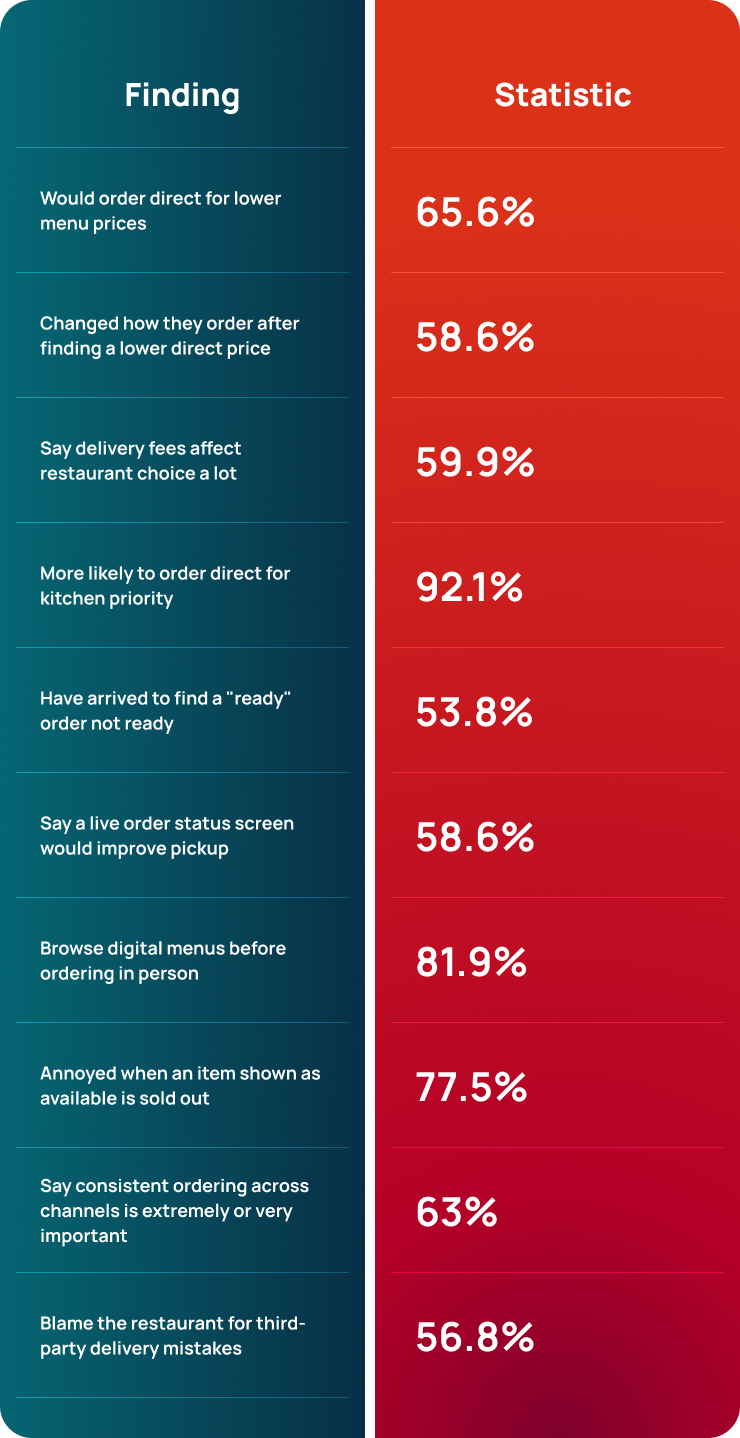
Below are 10 findings and the opportunity behind each.
Guest attitudes toward third-party delivery fees and first-party pricing
66% would order directly from you if they could get better deals
Nearly two-thirds of consumers (65.6%) say lower menu prices would move them from third-party apps to a restaurant's own app or website. No service fees came in second at 48%.
The opportunity
Make the first-party price advantage obvious. Direct orders avoid the 15% to 30% commissions aggregators charge, which gives brands room to share some of those savings. That can mean no menu markups on owned channels, direct-only value bundles, or waived fees above a minimum spend.
Guests will notice: in our 2026 Phygital Index Report, 58% of diners said they pay closer attention to price changes on digital menus.
59% changed habits after finding a lower direct price
More than half of diners (58.6%) discovered they could order directly from a restaurant for less, and that discovery permanently changed how they order.
The opportunity
Many guests stumble onto the pricing differences between a brand’s website and its 3P menu accidentally. As an operator, you may take this for granted, since marking up your menu on delivery apps is considered the norm in the industry.
To make guests more aware of the differences, you can use QR codes on third-party bags, receipts, or packaging to show the price difference and offer a first direct-order incentive that turns a marketplace customer into a direct one (depending on the rules of the delivery provider).
60% filter delivery apps by fees
Six in ten respondents (59.9%) say delivery fees strongly affect their restaurant choice, and they actively filter apps for lower fees.
The opportunity
On marketplaces, fees can decide whether you get considered at all. Use marketplace-funded or brand-funded free delivery promotions strategically, such as during slower dayparts, to stay visible. Keep your everyday best value on owned channels, where you aren't paying commission.
What guests expect from order pickup times and kitchen speed
92% would go direct for kitchen priority
Almost every respondent (92.1%) would be more likely to order through a restaurant's own app or website if those orders got priority in the kitchen. Well over half (58.6%) said "definitely."
The opportunity
Make kitchen capacity a reason to order direct.
With capacity-aware order pacing, brands can reserve faster prep slots, express pickup windows, or priority routing for first-party orders. It's a loyalty lever that doesn't cost margin, and it lines up with what guests value: our Phygital Index found speed (34%) ranks alongside food quality and convenience as a top driver of value.
54% have arrived to an order that wasn't ready
More than half of diners (53.8%) have shown up for an order marked "ready" only to find the kitchen still working on it. For 23.4%, it happens regularly.
The opportunity
A priority promise only works if the ready alert is accurate. Static prep timers don’t account for large swings in demand, like a slammed kitchen at noon on a Friday.
Tying ready notifications to actual kitchen status, such as KDS bump events, and adjusting quoted times based on live kitchen load keeps the alert honest.
Additionally, consider geofenced arrival tracking to help the kitchen time the order to the guest.
59% want a live order status screen
More than half of consumers (58.6%) say a screen in the restaurant showing order progress would significantly improve their pickup experience.
The opportunity
Order ready boards in the lobby, connected to the kitchen display, show guests exactly where their order stands. That means fewer "is mine ready?" questions at the counter and less crowding during the rush.
How guests use digital menus and react to out-of-stock items
82% browse digital menus before ordering in person
More than four in five guests (81.9%) check a restaurant's app or website to decide what to eat before they reach the counter or drive-thru. About a third (35.7%) do it regularly.
The opportunity
Treat the app and website as pre-visit merchandising, even for guests who never place a digital order.
Feature combos, LTOs, dietary filters, and saved favorites so guests arrive already decided. That speeds up the line and gives brands a chance to shape the order before it's placed.
Our Phygital Index points the same way: 62% of diners want menus that show items based on a price point they select.
78% are annoyed by items that turn out to be sold out
More than three-quarters of customers (77.5%) find it annoying when an item shown as available turns out to be sold out after they order. Half (50.7%) say it's extremely annoying.
The opportunity
When an item is 86'd at the POS, it should drop off every digital menu automatically, across web, app, kiosk, and third-party apps.
A platform that syncs with your POS prevents the refund, the substitution call, and the disappointed guest. It also protects how guests judge the visit: 33% of diners in our Phygital Index rank order accuracy as a primary factor in value.
Guest attitudes toward delivery errors and consistency
63% want ordering to feel the same everywhere
Nearly two-thirds of diners (63%) say it's extremely or very important that ordering feels identical across the app, website, kiosk, and drive-thru.
The opportunity
Run menus, pricing rules, customization flows, and loyalty balances from one platform so that the experience is consistent and loyalty data follows guests across channels.
Gaps show up fast when they don't. For example, in our Phygital Index, 23% of diners said they were frustrated by not being able to redeem loyalty points or coupons at a kiosk that they had earned elsewhere.
57% blame the restaurant for third-party mistakes
When a delivery order is wrong or missing items, 56.8% of consumers blame the restaurant. Only 19.8% blame the driver and 15.4% blame the app.
The opportunity
Your brand takes the hit for marketplace errors, so the responsibility to mitigate them belongs with you. Sending third-party orders straight into the POS removes manual tablet re-entry, a common source of those errors.
The common thread
Across all 10 findings, guests want fair prices, accurate timing, and an experience that holds together from the screen to the counter. The brands that close those gaps first will win more direct orders and keep more of the margin on each one.
Tillster helps QSR and fast-casual brands bring digital ordering, kitchen operations, and cross-channel loyalty onto one unified platform, giving guests a consistent experience and operators more control over every order.
Get in touch with our team to see how it works.