
|
Published on:
July 24, 2026
|
Published on:
July 24, 2026
Restaurant Order Management: Solve Errors, Delays & Lost Revenue
With the right restaurant order management approach, operators can simplify complexity, sync digital channels, and boost efficiency across every location.
Guests today expect ordering to be swift, sure, and entirely frictionless. In fact, according to the 2026 Phygital Index, 44% of diners rank convenience and 34% rank speed as their primary factors when choosing where to eat, while an overwhelming 97% look for app ease of use as a baseline requirement.
They want accurate dine-in service, fast drive-thru and pickup, delivery without friction, and clear communication about where their meal stands. Whether they come by kiosk, mobile app, website, or through third-party marketplaces like DoorDash and Uber Eats, the path should feel natural and error-free.
Yet for many operators, a hard question arises: how do you master this growing complexity without adding hands, slowing the line, or diminishing the guest experience?
The answer lies in upgrading your restaurant order management system (OMS) from a passive receiver of tickets into an active orchestrator of demand. Here is a breakdown of the most common operational challenges that come with managing uncoordinated volume across multiple channels, and how transitioning to a unified, connected platform solves them.
#1 Fixing ordering errors from too many ordering channels
Why do order errors occur?
Consider the sheer explosion of new ordering pathways happening in the industry right now.
Many brands now receive orders from a massive variety of sources: native online ordering (mobile apps and websites), kiosks, call centers, and multiple third-party delivery platforms. Without control, staff are forced to wander from tablet to tablet, manually re-entering orders into the register—a chaotic phenomenon known as "tablet hell."
Without a unified architecture, adding a single new digital channel means bolting on yet another disconnected system, instantly exacerbating the chaos for front-of-house staff trying to transcribe tickets and keep up with demand.
How does an OMS reduce order errors?
A dedicated OMS digitizes the flow of tickets directly to the kitchen, replacing manual entry and reducing the risk of lost tickets or human error.
When order management is integrated into a truly connected restaurant platform, orders from every channel are aggregated into a single feed and injected directly into the Point of Sale (POS) system. This completely eliminates tablet chaos, maintains near-perfect injection success rates, and gives your front-of-house staff a single, unified view of all incoming demand.
Imagine a regional taco chain running on a legacy POS system. When a customer orders a highly customized "Build-Your-Own" taco bowl through a popular delivery app, the platform's API instantly ingests the payload, maps the delivery app's unique item codes to the restaurant's standardized central catalog, and injects the order directly into the kitchen's system—all in milliseconds, without a single employee ever needing to touch a tablet.
#2 Managing busy kitchens and long wait times
Why do long wait times and kitchen bottlenecks occur?
We’ve seen exactly what happens when unmanaged digital volume breaks a kitchen’s workflow. Recently, major brands had to completely pull beloved new items because the operational complexity overwhelmed staff during peak rushes and disrupted the execution of core menu items.
Demand rarely arrives evenly. A lunch rush can flood the kitchen in minutes. In the early days of digital ordering, systems blindly accepted all incoming orders without regard for kitchen capacity, leading to missed promise times, overwhelmed staff, and frustrated guests.
How does an OMS reduce kitchen bottlenecks?
Modern order management relies on pacing controls, allowing managers to set thresholds for incoming volume or manually extend lead times when the kitchen falls behind.
When part of a unified platform, order management acts as an automated traffic controller. Using capacity-aware intelligence, the system monitors incoming demand and automatically throttles it during peak rushes.
Picture a busy burger joint during a Friday lunch rush. If the system detects a sudden flood of complex combo meals, it automatically recalculates kitchen capacity. In real time, it might push the estimated ready time from 10 minutes to 25 minutes across all digital storefronts, while simultaneously triggering a temporary pause on third-party delivery apps to protect the kitchen until the backlog clears.
#3 Keeping prices controlled and consistent across ordering channels
Why do pricing inconsistencies occur?
As restaurants expand across delivery, pickup, and third-party marketplaces, pricing becomes highly complex. With aggregators routinely hiking their rates, brands are seeing digital margins evaporate.
Operators often need to implement standard pricing in-store while applying specific markups to delivery platforms to offset high commission fees.
Without centralized control, operators are forced into manual price adjustments across dozens of disparate apps, which is time-consuming, prone to error, and results in severe margin leakage.
How does an OMS enable accurate pricing control?
Order management tools allow operators to segment pricing by fulfillment type, ensuring that delivery and pickup orders can be priced differently.
A connected platform takes this further by providing granular, global pricing controls from a single dashboard. Instead of manually updating prices everywhere, operators can configure channel-specific markups and push that update instantly.
Consider a national pizza franchise that urgently needs to raise prices by 15% exclusively on third-party apps to offset new fees. An administrator simply applies a markup rule to that specific delivery service. Instead of rebuilding and downloading massive menu files to every single store, the system surgically updates only the specific price fields, broadcasting the change across thousands of digital storefronts in minutes without disrupting ongoing transactions.
#4 Preventing out-of-stock orders and menu mistakes
Why do out-of-stock errors occur?
The stakes for menu accuracy have never been higher. According to the 2026 Phygital Index, 33% of diners now say order accuracy is a primary factor in how they judge a restaurant's value.
Nothing damages trust faster than accepting an order for an unavailable item. In a fragmented tech stack, an ingredient might run out in the physical kitchen, but still show up as available on the mobile app or a delivery site. Store teams are left issuing refunds, offering substitutions, and absorbing guest frustration because digital stockouts constantly lag behind physical reality.
How does an OMS prevent out-of-stock errors?
Digital order management allows store managers to quickly "86" (remove) items from their digital menus to prevent guests from ordering out-of-stock food, minimizing refund requests.
A unified platform automates this process through real-time POS synchronization. If an item or ingredient is marked unavailable in the store's POS system, the connected platform instantly and automatically removes it across all digital channels—including web, mobile, kiosks, and third-party marketplaces. This completely eradicates the digital-to-physical disconnect.
This is achieved by separating the POS's raw "technical truth" (the core catalog) from the digital "commercial truth" (the consumer-facing menu). Think of a fast-casual sandwich shop that suddenly runs out of a seasonal artisan bread. The kitchen manager marks the bread as "86'd" on their back-of-house register. The platform instantly catches this inventory flag. Within seconds, it hides the bread option on the mobile app, removes the item from the in-store kiosks, and rejects any incoming marketplace orders that attempt to request it, completely eradicating the digital-to-physical disconnect.
#5 Keeping guests updated and staff in sync
Why do miscommunication and pickup congestion occur?
Customers expect transparency after checkout. When orders from mobile apps, kiosks, and delivery marketplaces lack a unified operational view inside the store, the result is pickup congestion and inaccurate status updates. Front-of-house staff end up confused about what order belongs to whom, and guests are left waiting without knowing exactly where their meal stands.
How does an OMS keep everyone in sync?
Order management software generates automated notifications so guests know when their order is received, in prep, and ready for pickup.
A connected platform provides live tracking for both guests and staff simultaneously. While guests watch an in-store Order Ready Board (ORB) or a live delivery map on their phone, staff utilize a centralized “Command Center” screen to effortlessly manage check-ins, route orders to drivers, and time handoffs perfectly.
Imagine a modern cafe fulfilling a chaotic mix of drive-thru and mobile orders. The digital ORB reads routing logic from the cloud, displaying mobile pickups in a green lane and drive-thru orders in a blue lane, complete with visual alerts if an order is running late.
#6 Growing sales with smarter ordering tools
Why do restaurants miss out on sales growth?
Legacy ordering systems merely accept transactions; they fail to adapt to modern consumer behaviors. They miss out on the shift toward highly profitable first-party delivery, large-scale group ordering, and they fail to utilize the context of a guest's visit to offer meaningful suggestions.
How does an OMS drive revenue?
An advanced OMS supports high-value order types, enabling features like catering menus, group ordering links, and the dispatch of in-house delivery drivers.
When built into a unified platform, order management connects directly to your Customer Data Platform (CDP) and AI tools. By analyzing guest behavior in real time, the platform surfaces highly personalized upsells at checkout—lifting check sizes by an average of 24%.
This is powered by an AI recommendation engine that analyzes specific ordering contexts.
Envision a customer adding a spicy chicken sandwich to their mobile cart at 11:30 AM. Analyzing millions of data points for that specific location and time of day, the model instantly determines the highest-converting complementary item—dynamically prompting the guest to add a high-margin iced lemonade or a premium side of loaded fries.
Power your entire ecosystem with Tillster
As digital demand continues to grow, successful brands can no longer rely on bolted-together, fragmented systems. You need one connected platform that unifies the restaurant POS, digital channels, kitchen operations, and guest communications.
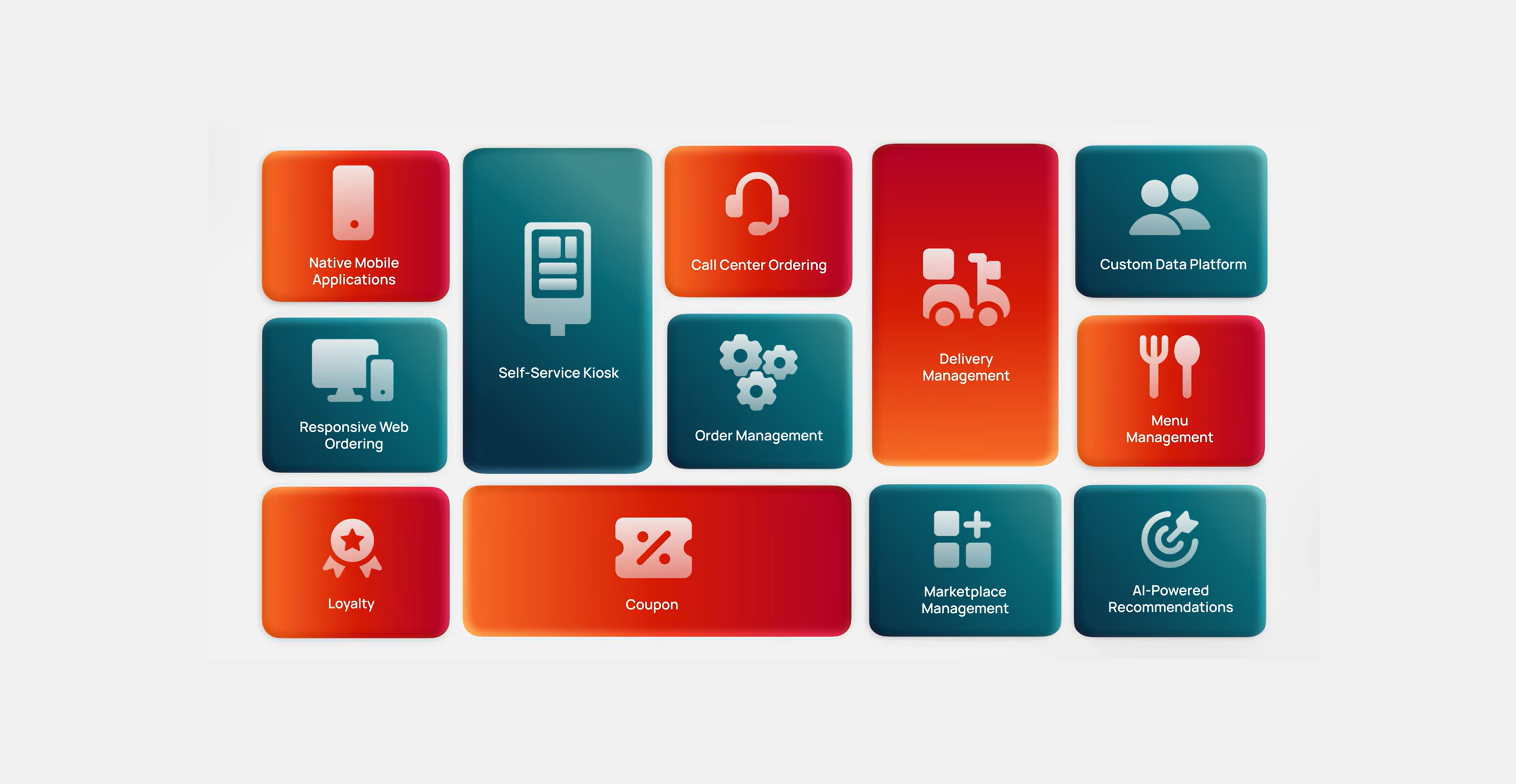
Tillster is the leading global provider of unified commerce solutions for enterprise restaurant brands. Tillster’s composable platform brings together your web and mobile ordering, self-service kiosks, delivery management, and loyalty programs into one perfectly orchestrated ecosystem.
Ready to stop chasing chaotic digital volume and start orchestrating highly profitable growth?
Popular Blogs

Restaurant order management FAQs
What key features should restaurant operators look for in an order management solution?
Some of the most important key features include POS integration, payment processing, real-time order status updates, kitchen routing through a KDS, centralized menu management, channel-specific pricing controls, and built-in reporting. These capabilities help restaurant operators optimize daily operations while delivering a faster, more reliable customer experience.
Can a restaurant ordering system help improve profitability?
Yes. A modern restaurant ordering system can improve profitability by reducing order errors, minimizing refunds, automating pricing updates across channels, and helping restaurants serve more guests without increasing labor costs.
Features like automated order routing and capacity management also help maximize operational efficiency during peak hours.
Is a restaurant order management system only for large QSR brands?
No. While many quick service brands rely on order management platforms to coordinate high transaction volumes, restaurants of all sizes can benefit.
How does POS integration improve restaurant order management?
POS integration connects your restaurant ordering system directly with your restaurant POS system, allowing orders to flow automatically from every digital channel into the kitchen. This eliminates duplicate data entry, keeps menus synchronized, improves order accuracy, and helps restaurant operators manage high order volumes more efficiently.
How do multi-location restaurants keep menus and inventory consistent?
For multi-location brands, a centralized platform with real-time menu updates and inventory tracking helps ensure customers only see items that are actually available.
When integrated with POS systems, out-of-stock products can automatically be removed across mobile apps, websites, kiosks, and delivery marketplaces.