
|
Published on:
September 21, 2026
|
Published on:
September 21, 2026
How to Improve Kiosk Performance Across Restaurant Locations
7 practical ways to improve restaurant kiosk performance across locations. Increase check size, reduce downtime, and optimize the guest experience.
Your kiosks are installed, your guests are using them, and orders are coming in. But are they performing as well as they could be?
For multi-location restaurant brands, installing self-service kiosks is only the beginning. The real challenge is ensuring every kiosk consistently delivers the results you expect, whether it's increasing average check size, reducing wait times, or helping staff manage the lunchtime rush.
A kiosk that performs well in one location might struggle in another. Differences in restaurant layouts, customer preferences, menu offerings, and operational workflows can all influence results. Even seemingly minor issues, like screen glare, unclear signage, or unnecessary steps in the ordering process, can create friction that affects the guest experience.
As kiosk adoption grows, these challenges become increasingly important. According to Tillster's 2026 Phygital Index Report, 64% of diners order at an in-store kiosk at least several times a month, up from 61% in 2025.
This growing adoption is a ripe opportunity to increase sales, improve operational efficiency, and deliver better guest experiences by getting more out of every kiosk across their locations.
Here are seven effective ways to make that happen.
#1 Measure kiosk performance across every location
You can't improve what you don't measure.
One of the biggest challenges for multi-unit operators is understanding how kiosks perform across different stores. A location with consistently high kiosk sales might look successful, but that number alone doesn't show whether guests complete orders efficiently or whether the kiosks capture their full revenue potential.
To get a clearer picture, establish consistent performance metrics across your restaurant locations.
Some of the most valuable metrics include:
- Kiosk adoption rate: What percentage of eligible in-store orders are placed through self-ordering kiosks rather than at the counter?
- Average check size: How does the average ticket size compare with counter orders?
- Order completion rate: How many guests successfully complete an order after starting one?
- Ordering time: How long does it take guests to move from the first screen to a completed transaction?
- Kiosk availability: How often are devices operational and available for guests to use?
These metrics help identify which locations are performing well and which may need attention.
For example, if two stores have similar guest traffic but vastly different kiosk adoption rates, the problem might not be the technology itself. One store could have better kiosk placement, clearer signage, or employees who are more comfortable encouraging guests to use the self-service kiosk.
It's also important to compare stores under similar conditions. A high-volume urban location will naturally generate different results than a smaller suburban restaurant. Looking at performance by store type, daypart, and transaction volume helps operators distinguish genuine performance gaps from differences in operating environments.
#2 Optimize kiosk placement for each restaurant's layout
Sometimes, improving kiosk performance doesn't require a software update or new hardware. It just requires moving the kiosk.
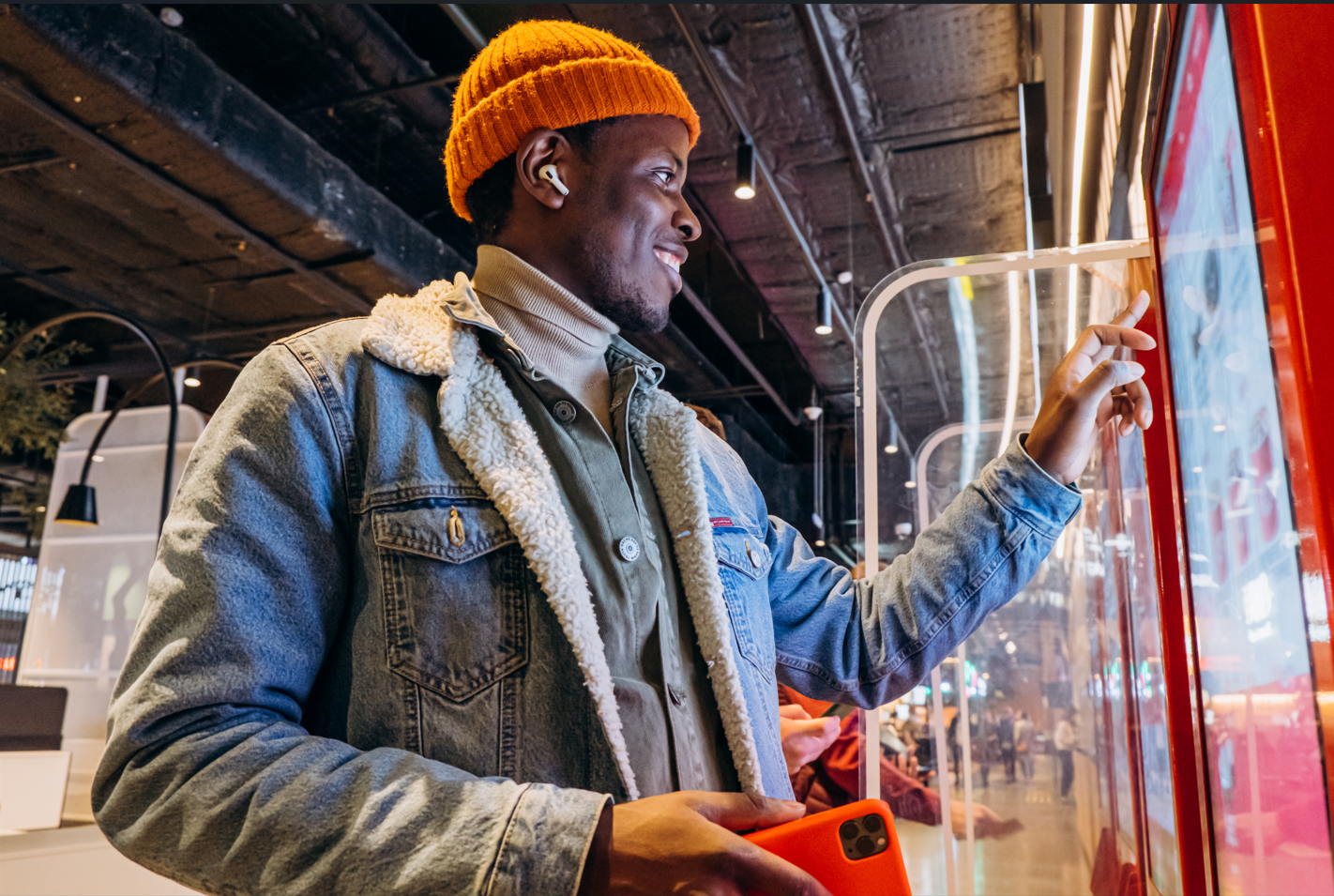
Kiosk placement directly influences whether guests notice, approach, and use self-service ordering.
A kiosk tucked into a corner might go unnoticed, while one positioned in a natural walking path can encourage adoption and help absorb demand during peak hours.
What works in one restaurant won't necessarily work in another. A large dining room might accommodate multiple freestanding kiosks near the entrance. A smaller location might benefit from countertop kiosks or wall-mounted units that preserve valuable floor space.
When evaluating kiosk placement across locations, consider:
- Visibility: Can guests easily identify the kiosks when entering the restaurant?
- Foot traffic: Are kiosks positioned along natural ordering paths without obstructing movement?
- Peak-hour demand: Can the placement help reduce congestion at the counter?
- Accessibility: Is there enough room for guests with different mobility needs to approach and operate the kiosk comfortably?
- Lighting and surroundings: Are touchscreens easy to see without glare or unnecessary distractions?
Clear signage also matters. Guests should immediately understand that a kiosk is available for ordering rather than mistaking it for a digital advertisement.
For multi-location brands, the key is to establish consistent placement principles while giving individual stores the flexibility to accommodate their layouts.
#3 Standardize the ordering experience without ignoring local needs
Guests shouldn’t have to relearn how to order when visiting different locations of the same restaurant chain. A standardized kiosk experience creates familiarity while allowing restaurants to meet local needs.
Keep navigation consistent, content flexible
Organize menu categories logically, use consistent buttons and navigation, and make pricing and customization easy to understand. Guide guests through one clear decision at a time instead of overwhelming them with endless scrolling.
At the same time, kiosks should accommodate regional offerings, menu availability, language preferences, and location-specific promotions without compromising the overall brand experience.
Make accessibility a priority
Clear touch targets, reachable controls, readable text, audio guidance, and appropriate physical interfaces help make ordering accessible to more guests.
Design for two types of ordering behavior
Tillster's High-Performing Kiosk Design playbook identifies two distinct ordering behaviors: Beeliners, who want to order quickly, and Explorers, who prefer to browse and discover new items.
Familiar shortcuts and clear navigation help Beeliners order efficiently, while thoughtful menu organization and visual merchandising encourage Explorers to discover new options.
The goal is a consistent ordering experience that adapts to each location and how guests prefer to order.
#4 Use dynamic recommendations to increase average check size
According to Tillster's High-Performing Kiosk Design playbook, 43% of kiosk orders contain just one item.
That represents an opportunity to introduce complementary products, upgrades, and meal combinations at natural points in the ordering journey.
But recommending the same products to every guest at every location isn't necessarily the most effective approach. What customers buy together can vary by restaurant, and guests who log in to their loyalty accounts bring another valuable source of information: their individual ordering history and preferences.
This is where contextual, personalized recommendations become valuable.
Rather than relying entirely on static upsell rules, restaurants can use store-level sales trends, time of day, items already in the cart, and loyalty data to deliver suggestions that reflect both the guest and the context of their order.
What an optimized recommendation engine takes into account:
- Store-level preferences: A burger might be frequently purchased with fries at one location but paired more often with a milkshake at another. Recommendations can reflect these local purchasing patterns.
- Loyalty-driven personalization: When a guest logs in to their loyalty account, the kiosk can use their previous orders and preferences to recommend familiar favorites or relevant additions. A guest who regularly orders a particular side, for instance, might see that item suggested alongside their meal.
- Real-time cart recommendations: As a guest builds their order, suggestions can change based on what's already in their cart. Someone ordering a burger and fries might see a drink recommendation rather than another side.
- Daypart relevance: Recommendations can adapt automatically throughout the day, highlighting coffee or breakfast additions in the morning and relevant meal upgrades later on.
Recommendation engines that combine these signals can surface relevant suggestions without adding friction.
To measure the success of your recommendations, track acceptance rates, average check size, and order completion to understand which suggestions are delivering value. The most effective recommendations make it easier for guests to complete their meals without adding unnecessary friction to the ordering process.
#5 Keep kiosks connected to your restaurant operations
Even the most intuitive kiosk interface can fall short if the systems behind it aren't working together.
Imagine a guest spending several minutes customizing an order, only to discover that an item is unavailable. Or completing a transaction at the kiosk and having an employee manually re-enter the order into the point-of-sale system.
Across a large restaurant fleet, disconnected systems can create inconsistent menus, inaccurate pricing, delayed orders, and additional work for employees.
Kiosk reliability is just as important as integration. Kiosks that depend entirely on cloud connectivity can become unavailable during internet or cloud outages. An on-premise mesh architecture helps reduce that dependency by enabling local order processing, allowing kiosks to continue accepting orders and routing them to the kitchen during certain network disruptions.
Kiosks should also be closely integrated with the restaurant's broader technology ecosystem, including its point-of-sale (POS), kitchen display system (KDS), menu management, and loyalty programs.
These integrations help ensure that:
- Completed kiosk orders flow directly into the POS and kitchen workflows without manual re-entry.
- Menus, pricing, modifiers, and item availability remain aligned with the restaurant's operational systems.
- Guests can access supported loyalty rewards and promotions during ordering.
- Kitchen teams receive accurate orders and can manage preparation efficiently.
Kitchen capacity is especially important during busy periods. A kiosk might successfully increase ordering throughput, but if the kitchen cannot keep pace, the result could simply be longer fulfillment times.
Restaurant brands should therefore evaluate kiosk performance alongside kitchen operations, using order pacing and fulfillment workflows to help balance demand.
When kiosks operate as part of an integrated restaurant ecosystem, they can improve the ordering experience without introducing new operational bottlenecks.
#6 Monitor kiosk health proactively across your fleet
A kiosk doesn't need to experience a major system failure to impact restaurant performance.
Something as simple as an unplugged device, an unavailable payment terminal, or an empty receipt printer can interrupt ordering. At a single restaurant, these problems might be relatively easy to spot. Across hundreds of locations, however, identifying and resolving them becomes significantly more challenging.
During a busy lunch rush, employees are focused on preparing food, fulfilling orders, and helping guests. They shouldn't have to constantly check whether every kiosk is functioning properly.
This is why proactive kiosk monitoring is an important part of managing a multi-location deployment. Instead of waiting for a guest or employee to report a problem, operators need visibility into kiosk health and performance across their entire fleet.
Remote monitoring can help teams identify unavailable devices, receive alerts about potential issues, and prioritize locations that need attention. This gives operators a clearer understanding of what's happening across locations without requiring them to physically visit each restaurant.
The best kiosk monitoring tools give operators real-time visibility into device status without requiring a call from the store manager. Look for a mobile-friendly interface that flags issues as they happen, not after a shift-end report, and one that gives store-level and multi-unit views so a regional operator can see fleet health at a glance instead of checking each location individually.
A regional operator responsible for dozens of stores can identify a kiosk that has become unavailable and coordinate a response before the issue goes unnoticed for an extended period.
Proactive monitoring also creates an opportunity to identify recurring problems. If the same device or location repeatedly experiences disruptions, operators can investigate the underlying cause rather than treating every incident as an isolated event.
#7 Build a continuous kiosk optimization program
Kiosk performance isn't something you optimize once and then forget about. An ordering experience that worked well six months ago might no longer be delivering the same results.
Guest preferences change. Menus evolve. New promotions launch. Restaurants experience different traffic patterns throughout the year. For multi-location brands, continuous optimization means establishing a repeatable process for identifying opportunities, testing improvements, and applying successful changes across the fleet.
A practical approach involves four stages.
Identify performance gaps
Start by reviewing kiosk analytics to understand where guests experience friction.
A useful method is to map the ordering journey as a conversion funnel, from the first screen through menu browsing, product selection, customization, cart review, and checkout.
If guests frequently leave before selecting a product, the problem might involve menu navigation or product discovery.
If guests build their orders but abandon them at checkout, investigate payment issues, confusing order summaries, or difficulty applying rewards.
Test targeted improvements
Rather than redesigning the entire interface, start with a specific hypothesis.
For example, a restaurant might test whether displaying popular meal combinations more prominently increases order completion or whether changing the timing of an upsell prompt improves its acceptance rate.
A/B testing can help compare different approaches while limiting the number of variables changed at once.
Validate results across different locations
An improvement that works at one store may not have the same effect everywhere.
Test changes across locations with different traffic volumes, customer demographics, and menu preferences before introducing them throughout the fleet.
Evaluate the results using consistent metrics, including order completion, average check size, ordering time, and guest feedback.
It's important to measure the overall experience, not just one outcome. A new recommendation flow that increases check size but significantly slows ordering might create problems during peak periods.
Scale what works and keep refining
Once a change demonstrates consistent value, incorporate it into the broader kiosk program.
Centralized software management can help brands maintain common standards and deploy improvements across locations while preserving necessary local configurations.
Continue monitoring results after rollout to verify that the improvement performs as expected. This creates an ongoing cycle of measurement, testing, refinement, and deployment.
Instead of treating kiosks as static hardware investments, restaurants can manage them as evolving digital ordering channels that become more effective over time.
Make every kiosk count
Improving kiosk performance means creating an intuitive ordering experience, keeping systems connected, and giving every location the tools and support it needs to succeed. With the right approach, restaurants can increase average check sizes, streamline operations, and deliver a more consistent guest experience across their entire fleet.
As a leading North American restaurant kiosk software provider, Tillster has helped restaurant brands deploy and manage kiosks across global markets. From initial planning and installation to POS integration, staff training, and ongoing technical support, we work alongside the world’s restaurant leaders to help them get the most out of their kiosk programs.
Ready to take your kiosk program further?
Popular Blogs


Kiosk Performance FAQs
Why aren't guests accepting kiosk upsell suggestions?
Usually because the suggestions aren't relevant or show up at the wrong moment. Offering fries to someone who already has fries, or a dessert at 8 a.m., trains guests to tap past every prompt. Smart upselling looks at what's already in the cart, the time of day, and what sells together at that specific location, then suggests something that actually completes the order.
Timing matters as much as the offer. Suggestions during customization and at checkout tend to outperform homepage promotions. Track acceptance rate alongside average order value and order completion: a prompt that lifts check size but causes guests to abandon has cost you more than it earned.
What should we look for when choosing a restaurant kiosk system?
Start with the systems behind the screen. Self-service kiosks for restaurants should integrate with your POS, kitchen, and loyalty programs so orders flow through without manual re-entry and guests can redeem rewards without asking for help.
From there, evaluate what separates interactive kiosks that drive results from simple digital order pads: the branded ordering experience, data-driven recommendations, central management across locations, and how the kiosk keeps running during a connectivity outage.
Provider experience matters as much as the technology. The strongest self-service kiosk solutions come from providers with a track record supporting multi-unit quick-service restaurants and fast-casual restaurant brands, including complex menus and high transaction volumes.
For the full breakdown, see our restaurant kiosk checklist.
How do kiosks improve order accuracy?
Guests enter their own orders, which removes the verbal handoff at the counter where most mistakes happen. That gain only holds if the kiosk sends orders directly into the POS system, with order routing to the KDS or kitchen printer and no manual re-entry.
The details that break order accuracy are usually menu logic, not hardware. Modifiers need to stay attached to the right item, required choices should be enforced before checkout, and sold-out items should disappear from the screen automatically so guests can't order something the kitchen can't make.