|
Published on:
July 30, 2026
|
Published on:
July 30, 2026
International Restaurant Expansion: Key Technology, Menu, and Brand Considerations
If you’re looking to expand your restaurant chain internationally, these technology, menu, brand, and guest experience considerations are key to get right.
Many of the restaurant industry’s leading brands are making global growth a central part of their long-term strategy.
For instance, McDonald's reportedly expects to add more than 1,800 restaurants in its international development licensed markets in 2026, including about 1,000 locations in China alone.
RBI, another restaurant leader, is reportedly working toward 40,000 locations by 2028, with international markets representing a targeted 7,000 new locations.
This focus on international expansion can be seen across U.S.-based restaurant chains; in 2024 their international locations grew by 4.8% compared to 1.4% domestically. That’s 3X more international locations added.
Why the focus on markets outside of the U.S.? There are several compelling forces pushing restaurant brands to look beyond their home markets:
- Untapped demand in growing middle-class markets: Many international markets have expanding middle-class populations with rising disposable income and growing appetite for Western and hybrid dining concepts.
- Diversified revenue and reduced dependency on one economy: Operating across multiple countries and currencies can reduce a brand's exposure to a downturn, regulatory shift, or saturation event in any single market.
- Faster unit growth through franchising and licensing: International franchise and master licensing agreements let brands scale unit count without carrying the capital burden of company-owned real estate in every market.
- Technology that makes remote operations more manageable: Cloud-based POS, centralized menu management, and restaurant commerce platforms make it easier to maintain consistency and oversight across geographically dispersed markets.
However, international growth isn't simply domestic expansion in a new geography. Every market brings unique operational, cultural, and regulatory considerations that require thoughtful planning across menu, technology, and the overall guest experience.
Understanding these challenges up front is what separates brands that expand successfully from those that stall out after their first one or two international locations.
The good news is that expanding internationally is more achievable than ever. Advances in cloud-based technology, global franchising infrastructure, and digital ordering and payment capabilities have made it faster to localize menus, guest experiences, and operations without sacrificing brand consistency or rebuilding systems for every new market.
In this blog, we’ll focus on the key menu, brand, technology, and guest experience considerations you should plan for when expanding to new international markets.
Choose the right international expansion model
Once a brand has a clear picture of a target market, the next decision is how to enter it, and how much operational and brand control it wants to retain along the way. The right model depends on the brand's risk tolerance, capital position, and how mature its operational playbook is for supporting partners at a distance.
Brands generally choose among three models, each with a different control profile:
- Corporate-owned locations keep full control over operations and brand execution, but require significant capital and on-the-ground management in an unfamiliar market.
- Franchising shifts most of the capital burden to a local franchisee while the brand retains influence over standards through franchise agreements and training. It's the most common path for international growth.
- Licensing transfers more control to the local partner, who may adapt the brand more heavily to local conditions. It can speed up entry, but comes with less day-to-day oversight.
Many brands mix models across markets depending on local conditions and the strength of available partners. The model you choose will influence how much you have over the menu, tech, brand, and guest experience choices that we cover in the following sections.
Adapting your menu to new markets
Menu adaptation is often the most visible (and undeniably the most tastable) form of localization. This can range from small adjustments, like spice levels suited to local palates, to more substantial changes, like new menu items built around regional ingredients and dietary norms.
Dietary norms tied to religion are often the most consequential adaptation a menu needs to make. In many Middle Eastern, North African, and Southeast Asian markets, halal certification is an expectation for serving Muslim consumers. In Israel and other markets with significant Jewish populations, kosher requirements can significantly influence menu design, ingredient sourcing, and food preparation practices.
Because both halal and kosher standards extend beyond the finished dish, brands often need to verify their supply chains, ingredient sourcing, food handling, and preparation processes to meet requirements.
In markets such as India, where a large share of consumers follow vegetarian diets, brands often need to expand their vegetarian offerings or develop entirely new menu items that align with local preferences and cultural expectations.
The goal isn't localization for its own sake. It's identifying which items and flavors genuinely need adaptation to succeed in a given market, while preserving the core items that define the brand globally. Brands that do this well usually treat a subset of the menu as non-negotiable, the items that carry brand identity, while giving local teams flexibility elsewhere.
Examples of menu adaptation for international markets:
- McDonald's India replaced its signature beef burgers with chicken, fish, and vegetarian alternatives, including the McAloo Tikki, to better align with local dietary and cultural preferences.
- KFC China significantly expanded beyond its core fried chicken menu by adding items such as congee, egg tarts, and other breakfast offerings, making the brand relevant throughout the day.
- Burger King Japan introduced market-specific products such as the Teriyaki Whopper, incorporating a familiar local flavor profile while keeping its flagship burger recognizable.
Global brand and guest experience considerations
Of course, guest expectations don't stop at your menu. How customers order, pay, earn rewards, and interact with your brand varies from market to market, making it essential to adapt the guest experience while preserving a consistent brand identity.
Localizing the digital ordering experience
Digital ordering needs to feel native to each market. That means local language, local currency, and familiar interface conventions, but it also means the ordering flow itself needs to accommodate how people in that market actually order, whether that's more delivery-heavy, more pickup-heavy, or built around different day-parts than the brand's home market.
Friction in digital ordering, confusing menu navigation, unfamiliar payment steps, unclear delivery options, costs a brand more in a new market than an established one. Guests who don't yet have loyalty to the brand have less patience for a clunky experience.
Brands should also account for differences in:
- Address formats and location services: International address structures vary significantly, and checkout should support local formats.
- Delivery expectations: Some markets expect precise delivery windows, while others prioritize speed or real-time courier tracking.
- Menu organization: Popular categories, combo structures, and upsell opportunities often differ by market based on local dining habits.
- Promotions and pricing: Regional holidays, meal occasions, and promotional calendars should be reflected throughout the ordering experience.
- Accessibility and connectivity: Ordering platforms should perform well across a range of devices and network conditions, particularly in markets where lower-end smartphones or mobile-first browsing are common.
Adapting the in-store ordering experience
Service models, dining habits, and attitudes toward self-service vary across markets, meaning the same in-store experience won't resonate everywhere.
Whether guests expect self-service kiosks, cashier-assisted ordering, QR code menus, or table-side service often depends on local dining culture rather than the brand's home-market operating model. Aligning the in-store experience with those expectations helps reduce friction while reinforcing a familiar, intuitive guest journey.
For on-premise ordering, brands should consider differences in the following:
- Ordering autonomy: In some markets, guests prefer controlling the ordering process through kiosks or mobile devices, while others value interaction with staff for recommendations, customization, or hospitality.
- Queueing behavior: Expectations around waiting in line, joining a virtual queue, or ordering from the table differ across markets and influence how restaurants should manage guest flow.
- Customization expectations: The level of menu customization guests expect—and how they expect to make those modifications—can vary considerably by market, affecting kiosk design and ordering workflows.
- Dining occasion: Markets with a stronger dine-in culture often require different ordering journeys than markets dominated by grab-and-go or quick takeaway occasions.
- Service etiquette: The appropriate balance between self-service and staff interaction differs by country and should be reflected in how technology is introduced into the restaurant.
Supporting preferred payment methods and fulfillment options
Payment preferences vary widely by country. Some markets are dominated by mobile wallets, others still rely heavily on cash on delivery, and card networks standard in one region can be uncommon in another. A brand that only supports payment methods familiar from its home market loses orders in markets where those methods aren't how people pay.
The same logic applies to fulfillment. Delivery infrastructure, third-party marketplace availability, and guest preference for pickup versus delivery differ by market, and the ordering experience needs to reflect what's actually available locally rather than a fixed set of options built for a different country.
For example, in Vietnam, off-premise restaurant ordering heavily relies on cash on delivery and local mobile wallets such as MoMo rather than traditional credit cards. Fulfillment is equally localized. Instead of drive-thrus and curbside pickup, restaurants typically integrate with scooter-based delivery fleets and super-apps like GrabFood and ShopeeFood, requiring ordering systems optimized for rapid handoffs.
Personalization, loyalty, and customer data considerations
Loyalty programs and personalization can strengthen guest relationships in new markets, but they need to be built with local data regulations and consumer expectations in mind from the start.
Copying a loyalty program from the home market wholesale tends to underperform, since reward structures and what guests find genuinely valuable can differ enough by market to need at least some local calibration.
Take KFC’s approach to its rewards program in two markets: In the U.S., KFC utilizes KFC Rewards, a straightforward, transaction-based point system. Customers earn 10 points for every eligible $1 spent on digital orders. Points accumulate and are manually redeemed for free food within a rotating digital "Secret Recipe Vault".
In the U.K., KFC bypasses traditional points entirely in favor of the KFC Rewards Arcade. Instead of hoarding points per pound spent, U.K. customers receive an in-app invite to play an arcade-style game after every order over £3. Customers play physical-style mini-games, such as "Hammer Time," to win instant rewards.
Aside from loyalty program design, data privacy laws and consumer sentiment towards data collection should be taken into account; European privacy laws (GDPR) impose strict rules on collecting, storing, and profiling guest data. Demanding full names, phone numbers, or birthdates for a simple loyalty point causes massive drop-off among privacy-conscious EU diners.
Building a technology foundation for global growth
As brands add locations, countries, currencies, languages, and regulatory requirements, the systems running digital ordering, POS, and menu management either scale with that complexity or become a bottleneck that slows every future market entry.
Supporting multilingual ordering and localized UX
Guests expect an ordering experience that feels designed for their market, not simply translated. Beyond language and currency, localization includes region-specific menus, imagery, address formats, date and number conventions, and user interfaces that reflect local expectations across web, mobile, kiosk, and third-party marketplaces.
Tillster builds these capabilities into its core platform, allowing brands to configure localized experiences across every ordering channel without maintaining separate applications for each market. Whether supporting right-to-left languages, market-specific product imagery, localized menu content, or channel-specific experiences, brands can adapt to regional expectations with more agility and control.
Managing POS integrations, payments, and tax compliance
Behind every localized guest experience is an infrastructure capable of supporting regional business requirements. POS providers, tax regulations, fiscalization rules, and third-party integrations vary widely between countries, making a flexible integration layer essential for global expansion.
Tillster handles these back-end complexities by abstracting them from the core ordering experience.
For example, when a brand expands across borders, Tillster’s platform avoids the need to rebuild the entire tech stack for each region's distinct POS, payment, and tax systems. Its payment and POS integration layers normalize API calls, allowing a brand to easily plug in localized payment processors.
To simplify tax compliance, Tillster typically relies on the local store’s physical POS to serve as the tax authority. The system automatically pulls and validates exact state, regional, local, or district tax rates during checkout. Because this data is reconciled directly with the POS, operators maintain accurate accounting alignment with local tax laws without requiring costly or time-consuming workarounds.
Navigating data privacy across markets
Countries increasingly have their own data privacy frameworks governing how customer data can be collected, stored, and used, and the requirements don't always align with the rules a brand's digital ordering and loyalty systems were originally built to satisfy. A technology stack that can flex to meet different regulatory regimes market by market avoids having to re-architect systems every time the brand enters a market with a stricter data privacy standard.
This applies as much to third-party vendor relationships as to a brand's own systems. Any technology partner touching customer data in a new market needs to be evaluated against that market's specific requirements, not just the brand's home-market standard.
Tillster addresses these challenges by building global privacy and security capabilities into its core platform architecture. Rather than requiring brands to re-engineer their systems for every new market, the platform is designed to accommodate regional privacy requirements through configurable compliance capabilities.
For example, Tillster supports compliance with major regulatory frameworks such as GDPR in Europe and CCPA in the United States by encrypting customer data in transit and at rest, hashing sensitive personal information, and supporting regional data hosting where required.
The platform also provides capabilities for managing customer consent and supporting data deletion requests, helping brands align their consumer data practices with local privacy requirements as they expand into new markets.
Centralized menu management across global locations
As the number of markets grows, so does the burden of keeping menus accurate, current, and compliant with corporate rules across all of them. Centralized menu management lets a brand push updates, pricing changes, and promotions from a single system while still allowing the local flexibility markets need, rather than relying on each market to manage its own menu data independently.
Tillster manages this complexity through its centralized administrative tools and menu management system.
For example, a global brand can manage its entire digital menu footprint from a single portal using a "golden menu" approach, while still giving regional operators the flexibility to override pricing or temporarily disable out-of-stock items.
Instead of forcing every international franchisee to standardize their individual POS databases, Tillster’s SKU normalization layer automatically maps disparate local register codes to a single master SKU.
This allows corporate teams to push promotional updates or menu changes across thousands of stores, even if those locations are running entirely different POS systems.
Creating an international growth strategy that scales
Brands that build for scale from the beginning make each new market entry faster and lower risk. A flexible technology foundation that supports multiple languages, currencies, tax requirements, and regional integrations allows brands to configure for new markets rather than rebuild systems with every expansion.
Partnering with an experienced global restaurant technology provider like Tillster can accelerate that growth. Beyond software and hardware, the right partner brings expertise integrating with regional payment providers, POS systems, and local operational requirements while helping brands maintain a consistent guest experience across markets.
Built for enterprise QSRs and fast casual restaurants operating at global scale, Tillster combines a flexible, composable commerce platform with decades of experience supporting restaurant brands across North America, Europe, Latin America, the Middle East, and Asia-Pacific.
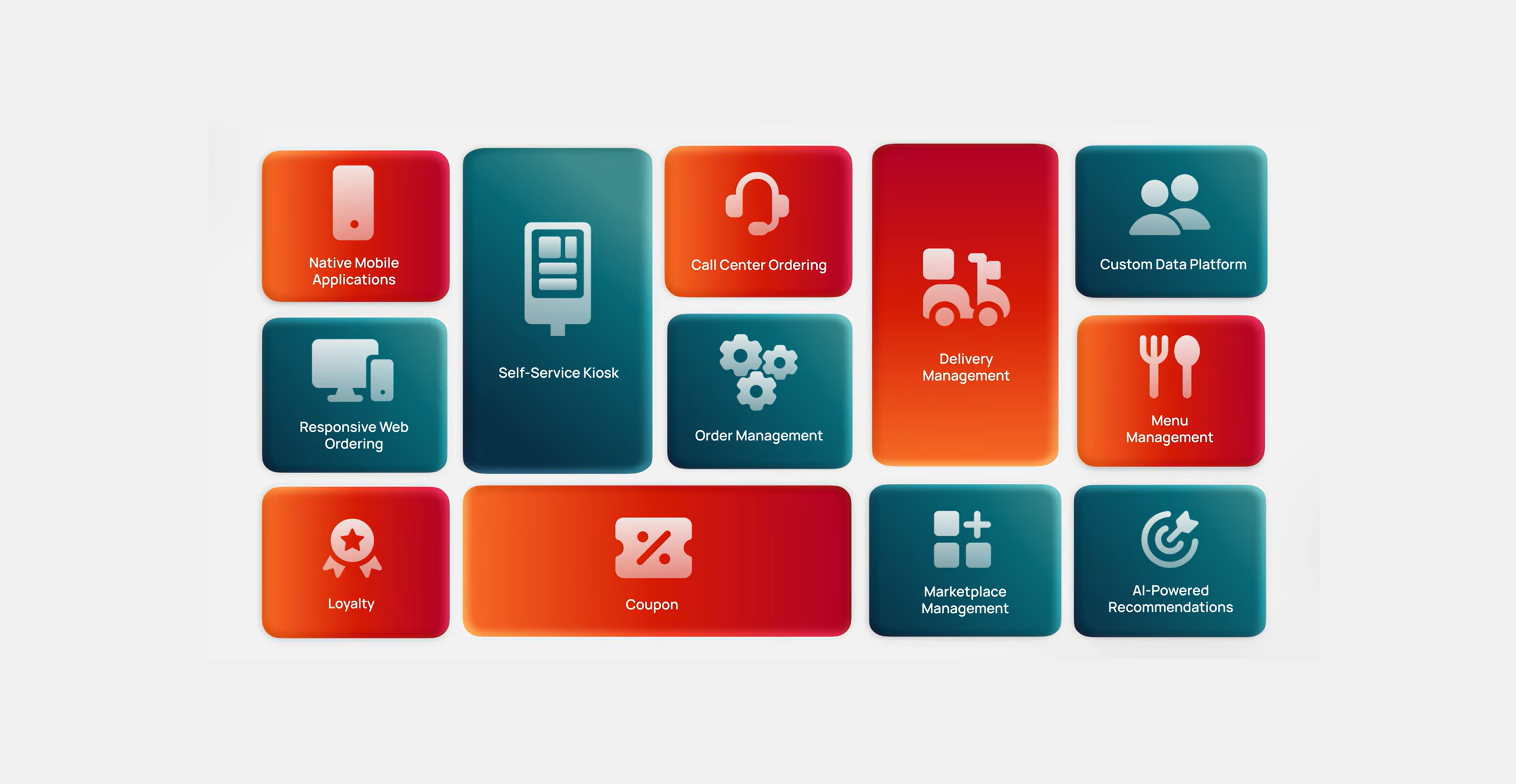
Powering more than 180 million orders annually across 40,000+ locations worldwide, the platform enables brands to deploy digital ordering, kiosks, loyalty, and dynamic menu management individually or as a unified solution—ideal for expanding into new markets where operational requirements, customer expectations, and technology ecosystems differ from those at home.
Popular Blogs


International restaurant expansion FAQs
What should restaurants consider before expanding into international business?
Before entering international business, restaurant brands should evaluate market demand, local regulations, cultural expectations, technology requirements, and operational complexity.
They should also determine whether overseas expansion aligns with their long-term strategy and whether growing beyond the domestic market offers opportunities to diversify revenue and reach new customers.
How does technology improve restaurant operations during overseas expansion?
Modern technology helps simplify restaurant operations across multiple countries by supporting multilingual ordering, localized payment methods, centralized menu management, and integrations with regional POS systems.
These capabilities allow brands to scale more efficiently while maintaining a consistent guest experience during overseas expansion.
What can restaurant brands learn from other successful international expansion strategies?
Many leading restaurant brands demonstrate that successful international expansion requires a thoughtful approach that goes beyond simply opening new locations.
For example, McDonald's has adapted its menu to local dietary preferences in India, KFC has modified its program for the UK, and Burger King has introduced market-specific menu innovations for its Japanese locations.
Brands such as Wingstop and Chipotle have also continued expanding into new international markets through strategic partnerships and franchise models.
While each brand takes a different approach, they share common priorities: balancing global brand consistency with local tastes, investing in scalable technology, and creating guest experiences that align with regional expectations.
How do franchise partners support international expansion?
Many restaurant brands use international franchising because it allows them to expand more quickly without making the same level of capital investment required for company-owned locations.
Experienced franchise partners bring valuable local market knowledge while helping brands maintain operational standards through training and franchise agreements.
How can restaurants compete with local competition when expanding internationally?
Succeeding against local competition requires more than offering a recognizable brand name.
Restaurants should evaluate local consumer preferences, refine their pricing strategy, adapt menu offerings where appropriate, and create a guest experience that reflects local expectations while maintaining a consistent brand identity.
Combining these elements with flexible technology and strong local partnerships can help brands establish themselves in new international markets.